|
=DRAMA LECTURE =A+B=C/1 + /2 + /3 + /4
|
 |
|
|
|
|
|
|
|
|
|
|
|
|
|
|
|
|
|
|
|
|
|
http://www.kultur.at/lesen/index.htm has most of my "dem handke auf die schliche" on line + the begleit link below has an interview that lothar stuck conducted with me about handke...
http://begleitschreiben.twoday.net/stories/2504464/o the various subsites:
http://www.handkedrama.scriptmania.com and is 'LYNX' PAGE to access the 12 other subsites.
THE DRAMA LECTURE FROM THE PROFANE TO THE SACRED & POSSIBLY TO THE IMPOSSIBLY ORDINAER???!!! WHAT WON'T HE TRY NEXT? PARTS A & B are posted below and so is C + the opening of D [Art of Asking] has been roughed out, with E [The Play about the Film about the War] to follow in very short order then.
|
A-1: The Modernist Period
THE SUMMA OF Handke's seven modernist pieces is THE HOUR WE KNEW NOTHING OF EACH OTHER, which has been a world-wide success but not necessarily for the reasons that Handke sought. Yet Handke like Brecht has a way of bringing out the best of those who work on his texts, or under his influence, as one can also observer in Vim Wender's film WINGS OF DESIRE, which is remarkable also for the fact that the quarter of the film that contains what you and I would call normal ordinary dialog is Wender's, if only because Handke who in person "scratches himself at the same places" refuses to write such dialog, except in quotation marks, either in the artificial space of the theater or in his prose. His is not the "aha" theater of oh I have seen this before this is just like what my friends and I do.
Although a play without spoken words, the written text, the directions, the score of HOUR, happens to be one of the very great virtuoso performances in the language, which is why, so it is my guess, Steve Pearson who did a first rate performance of the play at the University of Washington Drama School in the mid-90s, at one point put in a quote from Bach's unaccompanied cello sonata, though he might have used a section from the Goldberg Variations. Because that is what the piece is too: no longer just a the strict serial sequencing of the plays from PROPHECY via PUBLIC INSULT & KASPAR to QUODLIBET & MY FOOT MY TUTOR to RIDE ACROSS LAKE CONSTANCE, but a holographic, three dimensional one because images have been added to enrich [also with ambiguity, CREATED in part via contradiction] the individual [s] and groupings as the appear, and reappear and transform themselves during the course of this play without words. For, because HOUR was completed around 1990, nearly twenty years after LAKE CONSTANCE, it perhaps also inevitably comprises certain lessons, experiences, changes in Handke the artist that transpired during that interval. In other words, it comprises some of the features of Handke's transition from his radical, archaically rooted modernism to a more open, geologically oriented sense of time ["the epic of the every day"] but also his turn to firming each of his sentences up with an underlying image, and the realization that such a play of images can have the same dissociative effect as the language games of RIDE.
Within the play of theme and building variations, several matters, however, remain constant, chief of them THE BRIGHT LIGHT OF THE PLAZA. The play works on the purely phenomenological level, and one reason for its great success may lie in it being experienced as merely a succession of intriguing, amusing succession or non-succession of images: How tired we all are of OUR LANGUAGE... because of its misuse, our ears of being drenched with lies since childhood.
For example...
" Both groups had been stopped, briefly, by an electric cart on rubber wheels that had cut between them, with two men with visor helmets who are transporting a coffin, the plaza fool at their back, hands folded over his stomach, tiptoes in as a mourner; then without further ado, the two groups quickly exchange their clothes and belongings, as if this had been planned all along, and depart again, each in their own direction"[my translation]... can can scarcely be said to be an idyllic image, yet it has the same appearance of a rational transaction as the verbal transactions of RIDE do, this, as it were, is a Wittgensteinian word game but now performed by imagistic means.
Of these changes that occurred between the modernist and the mythopoeic perhaps the most important is that of the creation of a sacred nameless playing space with WALK ABOUT THE VILLAGES [W.A.T.V.]
"At dusk it is quiet and empty there, the mounds are enshrouded , the glaciers have melted just now, it is ten thousand years before out time, and it is our time...."
"The last dramas are those of places..."
"Land, lower your flag and coat of arms. Valleys all, strike your hymns, forget your names. Ways here, shelter yourself in namelessness... Construction site, here, you too, as in the old saying, animate yourself in nameless simplicity."
"We are the figures walking in the distance through the fields, the silhouettes in the cross country bus which drives through the snow plain. Our shadow faces fill the first to last subway are and only in the curves do our eyes briefly lose touch..."
"I saw this spot as the colors and forms which had been cleansed of everything secretive, everything parochial, everything atmospheric, everything typical, everything manic...."
as compared to the entirely profane stage space occupied by the plays of the 60s and early 70s, though THE RIDE ACROSS LAKE CONSTANCE's [RIDE] verbally dissociative methods, reprised in HOUR in the form of imagistic dissociations, create a state of mind quite proximate to the sacred in their cleansing. That creation, too, can be discerned in some of the other works of Handke's "Slow Homecoming" period and its quartet of works, the prose narrative A SLOW HOMECOMING, THE LESSON OF SAINT VICTOIRE & [W.A.T.V.]
If you disregard the two mytho-poeic plays that followed the modernist phase - W.A.T.V. & THE ART OF ASKING, but which immediately preceded HOUR, HOUR does not seem all that radically different from his first seven modernist plays: yet one way or another it comprises and reprises nearly all their methods. Thus the term: SUMMA. And my notion that one fairly efficient way of presenting Handke's modernist period is to discuss HOUR also in terms of what it comprises of the early plays. Its methods are not only just archaically rooted in the simplest of sequential compositional methods but now, also, in historical myths = thus my term MYTHO-POEIC = going back to the Gilgamesh; no end of fairy tale motifs are quoted, though you do not need to catch the references - this is not a crossword puzzle for literature professors; Eleanor Palascu, a first rate student of the great Austrian know-it all of postwar II Austrian literature, Helmut Schmidt-Dengler, has tracked most of them down [1]. As a matter of fact, the sheer inability to catch the references provides an air of extraordinary ambiguity to the experience of watching the play transpire as it involves your eyes. First one, then two, then four, eventually all twelve [though the play allows for fewer or more performers] impersonate something like forty-eight different creatures, making for hard work for the wardrobe. This troupe, I call it the Handke troupe, made its first appearance in that film-play/novel ABSENCE, then wandered into THE ART OF ASKING [the second of the MYTHO-POEIC plays, but actually also appeared as "leaf masks'"in the first of them W.A.T.V. :
" A few centuries ago it was the practice in this valley to make so-called leaf-masks. Between woodcut leaves a a mouth opened and out looked human eyes. Once I saw us - not just us three - thus together in the foliage, I walked late in fall through a large park that was covered with fallen leaves, the afterglow of the sunset sky on them, the leaves moved lightly between the blades and sometimes one of them also leaped up or flipped over, and while I moved slowly through the leaves all our faces and all our stores rose form the foliage: it was one face and one story, and this one face and the one story that I know now, should be the goal of the work, not only of my work but of all our work. The movement of these fallen leaves in the grass was the gentlest that man has ever seen! But now it is as though only a few single leaves chased after me in the dark crackling and rusting like dogs or pursuers."
And perhaps also this one:
" Wretched is everything, from here to the horizon, and here is the pain, forever. I will turn to me dead. Haven't they been the green field on my breast time and again? It is them I address in the dark, and they appear, in the eye of the cat, in the branch brushing the window in the night-wind, even in the humming of the ice box. The skeletons lie there stretched on in the earth and can be approached. I will squat down with them, and that will do me good. No, they don't want anything from me and are not angry. I think myself free of everything - and they are there, not as the dead but as my saints and helpmates. I show my profile to the false abundance of the here and now and they form the interface profile in empty space. I let them be around me and my evil blood flows differently. My dead are not ghosts of the night - they are part of the brightest daylight, and I touch them not when I sleep but when I rest...[2]
This is the comet's trail of the past as it flies off into the future... And the troupe keeps popping up here and there at future work at the most unexpected moments...also in the novels. Here it is at its most variable.
Handke completed HOUR so belatedly, he said, because he could not see in the 70s, how the the troupe could get together, as they do at one particularly important moment in the play, as all these individuals do at one point, and it isn't a question of a pile up after a sports score, or a mosh pit, but this, their coming together, after all their disparateness, into a connected group had to be felt; this is not some demonstration of a hideous and propagandistic and fascist slogan like Bill Clinton's "we are all in this together", something like a Seattle Post headline "let the mourning begin," or Kennedy's fascist slogan, first voiced by Hitler, no doubt courtesy of Goebbels, "do not think of what your country can do for you, but what you can do for your country." It's the kind of coming together that happens at certain parties: suddenly... there it is, that moment, it arises out of the babbling... and it is always such an astonishment when it does... and can be achieved only artificially with the ingestion of certain drugs. And this feeling I am pretty sure Handke, possessed by "tinny derision until the early 70s, was incapable of authentically feeling, had little imaginative access to, until well into the 70s, and then representing....
Then he couldn't see how the troupe might fall apart again! Until he realized that there is always someone around who will put a knee to the back of your knee, and as indeed there are, everywhere, at all times; which thought, of Handke's, however, is also revelatory of him, since there are so many other reasons one might find for the disintegration of those rare moments... fatigue... a sink hole opening up... etc.
I recall that the first time I read the text I was living in a small village/town in Baja California Sur, I felt as though someone had taken me by the scruff of my.... SYNTAX, and I actually turned around, thinking it might be one of my playful goats having a tug at my sombrero, a quality that unfortunately does not come through in the published translation [which is not mine] and not only because English, compared to German, is comparatively lacking in those kinds of syntactical hooks. By the time of that odd so metaphorically expressed sensation inside my head I had of course come under the rule of the power of Handke's syntax in other ways, and was even thinking of calling my tome HANDKE: THE DICTATOR OF SYNTAX or: HOW YOU CAN NOT ESCAPE THE PRISON HOUSE OF LANGUAGE BUT ONLY MAKE THE PRISON MORE PERSPICUOUS. Also, as soon as I read the text I realized: here it is: the missing play! The final resolution of the early work.
For example: While living in the St. Monica's just north of Los Angeles in the late 80s and reading Handke's THE REPETITION, the rhythms and pace of the syntax enabled me not only to walk more slowly, but to appreciate the state of mind, the state of mind of the "king of slowness" that Handke had become as he wrote that book and walked that book out of himself in the Dolminen of Slovenia. He simply exerts himself through his syntax. In WALK ABOUT THE VILLAGES, the first of the great mytho-poeic plays, the characters each speaks their long speeches in a syntax of their own [see section C, anon], something that I became aware of only gradually, and that you can't reproduce as a translator except to let the author exert himself through you... In that respect you can be nicely passive I realized, since these deeper rhythms are not reproducible as, say, all kinds of poetic meters might be.
THAT IS ONE OF THE THINGS THAT THEATER CAN STILL DO IN OUR MULTIMEDIA AGE, IT CAN SLOW DOWN TIME, IT CAN MAKE US SEE, it can refresh the senses, and provide an experience of the sacred, where things can be re-named.
Once Handke had passed through the grave crisis in his personal life, which you can see detailed in the books WEIGHT OF THE WORLD, A MOMENT OF TRUE FEELING & NON-SENSE & HAPPINESS, and as he comes out of it in THE LEFT-HANDED WOMAN, during the early to mid seventies, he became one of the last great walkers on this harried earth ["It has become hard to walk on earth." W.AT.V.], also for health reasons, so as not to be subject to claustrophobia, to be more open to the world and so as not be subject to the psycho-somatic constrictions around his heart... so as to lend a certain biological foundation to any post modernist musings... which might extend to recalling that the author of ODRADRECK was suffering from consumption when he created that creature of the wheezing and rustling lungs, which phenomena are not necessarily the consequence of being the offal of Late Capitalism.
" The classics," as Handke said, "became my salvation," but not a salvation to retreat into, but to have stronger ammunition for his modernist project. "Let the word become active," as the quote at the head of NO-MAN'S BAY has it. And he did not write HOUR because he happened to want to reproduce life on a plaza, as Alan Riding, the perpetually innocent New York Times European cultural correspondent, was square enough to take Handke at his disingenuous word.
Seeing these images pass singly, doubly by, their repetition, variations, seeming sense and non-sense, does of course nothing like grab you by the scruff of your syntax, images cannot do that. Yet this kind of procession does something to your eyes and to your way of seeing: more precisely = just the way Handke, the sight collector, sees more precisely = and this kind of focused, refocused seeing entrances you, somewhat, DISSOCIATES you from other parts of yourself, with the ultimate result that it leaves the audience with ALL its senses refreshed. The idea behind the piece is realized in what ought to be called a positivist cleansing manner, and it is as a cleansing that this piece and several others early and later plays connect with one of the earliest functions of theater. As the successor to Brecht, Handke does this in the same non-Aristotelean but I would say more playful manner: there is no catharsis here, perhaps a series of small catharses, and as you may or may not know one of several methods of treatment that Freud abandoned early on was the emotionally cathartic one, not because it wasn't quite wonderfully effective, but because it had to be repeated over and over; just as the Greeks did; just as the hypnotic method had to be abandoned because though the hypnotized subject might tell you everything in the state of being hypnotized they refused to acknowledge it once they were awake and therefore were unable to do anything with it. HOUR sort of half mesmerizes you, you regress just a little, but of necessity need to stay awake, keep being reawakened by the intrusiveness of the anti-idyllic... you cannot, as the audience, really regress... are ultimately put into a healthy dissociated state of mind. That is what I mean by playing on a dream screen, and that constitutes the filmic quality of the piece, which seems to create a revolving stage of its own.
The Old Possum once wrote a beautiful simple essay on why poetry was useless. And it is my fairly well educated guess, with the analytic and scientific training I have, that such an experience would be judged to be also a positivistically positive experience on the most positivist naturalist brain scan MIR level, and like psycho-analysis promote the growth of dendritic brain cells that are needed for new connections. As compared to no end of deadening, diversions....A certain kind of poetry is good for you.
A-2
THE HOUR THAT WE KNEW NOTHING OF EACH OTHER comprises the following procedures form the first seven works, some more obviously than others, and a production of the play will, I imagine, be more precise if it regards HOUR from those perspectives, as well as keeping in mind, as cited above, that it is also the third of the mytho-poeic plays, and of course the moment in history, and venue where it is performed. However, I am not in the least interested here in proficing a reading of these individual plays, only in pointing out their inter-related components, etc.
1] It maintains the solipsist, critical Wittgensteinian, if you will, logical identity from the first play PROPHECY:
" ABCD: The stuck pick will bleed like a stuck pig. A: The average person will behave like an average person B: The bastard will behave like a bastard. C: The man of honor will behave like a man of honor. D: The opera hero will behave like an opera hero. A: The heart will be heartsick. D: The skin will be skin-deep. C: The bloodsucker will be bloodthirsty. B: The threads will be threadbare. A: The stone will be stone-hard. ABCD: Every day will be like every other."
Here Handke, as it were, lays down the Wittgensteinian law of identity: everything that is the case is the case, the kind of law that actually dispenses with any possibility of the existence of a godly consciousness that is aware of everything that is simultaneously occurring in the world, but playfully. Moreover, Prophecy, is truly prophetic: it says: these are the components I will use, these are my building blocks. Yet by the time this, the simplest of serial sequences, was composed in 1965, it might be good to remember that Handke had written DIE HORNISSEN, a deconstructive novel of considerable complexity, the first attempt at fulfilling the yearning he had dreamt at age 12; had written most of the pieces that are collected in DIE BEGRUESSUNG DES AUFSICHTSRATS, which contained the condensed virtuoso retelling of Kafka's THE TRIAL; and done quite a bit of fine work for Austrian Radio, such as a radio script of CRIME AND PUNISHMENT.
It is also good to recall that Handke said he started to have an easier time of DIE HORNISSEN towards its end - which is noticeable for its tentativeness, and the subjunctive, the "as if "state in which "truths" are suspended while the narrator puts these truths into a non-naturalistic suppositional and manifest a delicate phenomenological registry - because he found himself becoming more playful. Yes, the realization that these texts are play texts and that, therefore, the experience of some of them lift "the weight of the world" off us, if only for a few hours....
And so PROPHECY does pretty much the same thing, playfully, as Susan Sontag would, in such a different fashion, in her Illness as Metaphor, in exploding the misuse of false analogies. Thus it is quite something, or was quite something, to come, approximately 30 years later, and particularly if you happen to recall his origins in the anti-metaphorical, on Handke's extraordinarily apt and judicious use of metaphor in his film dream novel One Dark Night I Left My Silent House QUOTES .
The notion of Wittgensteinian solipsistic logic Handke of course also applies to actors being able to be nothing but actors, players on the play spaces, this goes for the first as well as transitional play THEY ARE DYING OUT and the second, the myto-poeic period, with the difference being that that cavalcade of mythic and fairy tale characters who mingle with the people of our current everyday in HOUR suggest more than they represent, and perhaps also turn the current every-day walkers and runners into fabled if not fabulous every day creatures. Handke the magician!
HOUR is as unsettling in its unending presentation of dissociating images as PUBLIC INSULT, as I now call OFFENDING THE AUDIENCE, although Roger Downey once suggested Abusing the Audience, which, no matter how much audiences ought to be abused in every which way, is unfortunately impossible in the current linguistic climate, which even has the legal category "verbal abuse"; in certain country regions Cussing the Audience would work as the most fitting translation of the title.
Sections such as: "Try not to blink your eyelids. Try not to swallow any more. Try not moving your tongue. Try not to hear anything. Try not to smell anything. Try not to salivate. Try not to sweat. Tr not to shift in your seat. Try not to breathe..." indeed put the audience into the "crossfire" of the players' word; forty five minutes of that, which fail to leave out any detail or general statement that can be made about an audience - except its shopping and eating habits, which an intelligent director may add whenever they are pertinent - instill a high degree of self-consciousness in the audience, which the progression of images in HOUR, however, does only in a far more attenuated fashion, if only because the images are ambiguous, and lack the same in your face quality, weaves that quality among its other strands....
By making the audience the subject, P.I. unsettles and prevents group regression into consumership, in Seattle it happens to be, chiefly, of interior decorating, Restoration Hardware theater I call it, and Bon Marche shopping at the three official houses; it re-individualized each member of the audience, makes them aware of what theater, being in the theater is, and potentially - IT IS A GAME, A PLAY, SO IT IS NOT AN ACTING OUT, BUT RETAINS a soupcon of danger -[PHOTO-GOAT, bottom of http://handkelectures.freeservers.com/photo.html
- each member of the audience becomes the potential sacrificial victim that is one of the roots of theater, sacrifices, lynchings, guillotinings. The sadistic guffaws of the audience at the cruelties on stage... At one of the first performances of P.I. in New York, at the Goethe House, an analyst observed that the audience had received a rare lesson in group consciousness raising, something still to be devoutly wished for among the slugs of Seattle... where Roger Downey, when a Handke festival seemed in the offing, pleaded with me to let him troupe from theater to theater with a troupe, and perhaps since he was the only intillegent reviewer in town, the theaters would have given him permission for this ambiguos lark. Very little new has been produced except for some of Elfriede Jelinek and Rene Pollesch text on the relationship of audience and the theater since Handke wrote PUBLIC INSULT.
It is noticeable that the "laws of formalism" - so simple in the PROPHECY litany - are retained in P.I., yet within the blocks of allocated space, have become far more varied, and the formalistic laws can be as little disobeyed here as in pieces of music. In KASPAR, whose development is far more complex and multi-voiced, the variables will increase once again, near exponentially. From KASPAR, to LAKE CONSTANCE & finally to the complexities of HOUR....which can all be reduced, as HOUR does initially, to PROPHECY'S 1 + 1 = 2. Not the sort of thing American playwright can do by holing up in a hotel room to do rewrite a couple of weak pages - a songwriter being another matter.
By preventing that safe, consumerist, or whatever regression, or if you don't like that word, couchpotatohood, general sleepiness that is already looking forward to the far more interesting eateries here in Seattle, P.I. gives each theater-goer just a hint of becoming the original sacrificial animal on this wonderful photo which I presume to be Edward Albee's Sylvie being torn to pieces as these great Afghan tribesmen, to use Handke's compatriot's and fellow Carinthian Schwarzenegger's appellation, civilize themselves into becoming girlymen, their nonetheless indefatigable chivaness on this photo @:
http://handkelectures.freeservers.com/photo.html
I myself, if I were to direct P.I. now, would probably do it hip-hop style. The simple sentences lend themselves to that, and their see-saw effect would prove a nice compromise between making you sing-song somnolent and awakening...between being overly aggressive and powder-puff light. P.I. also happens to be a most important essay on the theater, on being not just in the theater, but in the world...
The famous insults at the end are a musical joke, like Haydn's in the Surprise Symphony, a series of chords, but made up of insults, that neutralize each other. These need to be updated, and I wrote a really tough piece on that for a translation magazine which can be found on the translation page of the main scriptmania site:
http://handke.scriptmania.com/custom4.html & at the home page of the handke.translation site
http://www.handketrans.scriptmania.com/
Handke's most recent play, SUBDAY BLUES, [2004] which might come out of a drawer from his first period, uses a single Wild Man to address subway passengers at stations "all around the world" as asurrogate for the audience. The piece is twice as long as it ought to be, and even if it weren't, unfortunately becomes quickly monotonous. It is devoid of a blues quality that pervades so much of the "melancholy player's" other work, where, in one instance, it took the form of three wild Credence Clearwater/ Dylanesque chants in WALK ABOUT THE VILLAGES.
Moreover, SUBDAY BLUES is scarcely as wild as Handke's roundhouse public outbursts are, especially if they have been brewing for a long time, such his famous or infamous attack on Hans Magnus Enzensberger. In fact, if you have followed Handke for several decades, especially from psycho-analytic perspectives, the list of matters that irritate the "Wild Man" is a kind of summa of matters that irritate Mr. Handke.
The Wild Man ultimately becoming more irritated by himself than any passenger or thing he encounters at these subway stops and turning the attack on himself, this self-loathing, is one of the components of Handke's incipient depression, but just one, but here is self-consciously employed. There is little reason for the piece's existence except that Handke seemed to have felt the need "to pop back into the picture" [to ring a change on "stay in the picture"]. I see no earthly need for this piece, especially coming on the heels of the great PLAY ABOUT THE FILM ABOUT THE WAR and the delightful, and light, and serious LA CUISINE, and it is difficult to imagine the same person writing DON JUAN [AS TOLD BY HIMSELF] and SUBDAY BLUES as long as you are sentimentally unaware of how Mr. Handke can compartmentalize.
The performer of the Austrian premiere [the play was first done at the Berliner Ensemble - see:
http://handkelectures.freeservers.com/photo.html for a number of shots and also the main and second drama site
http://www.handke.scriptmania.com/
http://www.handkedrama2.scriptmania.com
mentions that he made all kinds of discoveries in the text during rehearsal. I have read it three time and well recall the extraordinary experience that it can be to direct and rehearse the early texts: the amazing discoveries that everyone makes in the process of creating these processes, how musically interconnected everything becomes, how differently you start to speak and experience language. And so I may be quite wrong despite three readings. It would be a first. Peymann went all out in mounting a super production it appears, with every member of the Ensemble getting to play "passenger", and arranging readings from Handke's beautiful texts all over town! Perhaps also to counteract the dis-favor that this piece, which was mounted perhaps only to indulge its author's wish "to stay in the picture," might garner for him; or to have a chip in the favor bank when it comes to extracting a great piece from Handke further down the line, as Peymann has managed to do during the later years. And then said that "it wasn't that important." No I don't think it is important unless it signifies Handke's shift away from ambiguity and to some form of naturalis; it doesn't add anything to theater nor to its sub-genre Performance Art. [So there, for the first time in 40 years, there is something, aside a few essays, and some sections in Sierra del Gredos I could easily live without.
SELF ACCUSATION'S PATHOS, though extended here into the realm of humor, turns the confrontational method of P.I. on its head, in that the two characters that the text calls for itemize all the matters they have done to earn the displeasure of their and their fellow beings conscience, and does so in the form of the confessional. Towards the end, at the summation, there is the first major instance, at least of the kind that I have noticed, of extraordinary Handkean pathos that will mark his entire homecoming cycle - from A SLOW HOMECOMING, A CHILD'S STORY, THE LESSON OF ST. VICTOIRE but especially Nova's great dramatic poem which is the culmination of WALK ABOUT THE VILLAGES. The summation of SELF ACCUSATION begins:
" I came int the world afflicted with original sin. My very nature inclined toward evil. My innate viciousness expressed itself at once in envy of my fellow sucklings. One day in the world I was no longer free of sin. Bawling, I craved my mother's breast...." and extends for three entire closely printed pages of text "I failed to subordinate my physical nature to my spiritual nature. I denied my nature. I ran up against the nature of things. I indiscriminately sought power. I indiscriminately sought money. I failed to teach myself to regard money as a means" and ends in a somewhat Kafkaesque fashion "I did not raise my hands above my head. I did not aim at the legs. I played with the trigger of a cocked gun. I failed to save women and children first. I approached the drowning from behind. I kept my hands in my pockets. I took no evasive action. I did not let myself be blindfolded. I did not look for cover. I offered an easy target. I was too slow. I was too fast. I m o v e d.
I did not regard the movement of my shadow as proof of the movement of the earth. I did not regard...etc etc
I went to the theater. I heard this piece. I spoke this piece. I wrote this piece."
Originally the play's last line was: " I will never do it again" indicating that Handke may indeed have had no further plans for plays at that time, the further production of plays then necessitating the elimination of the line. And so, though the seven pieces that HOUR comprises, the whole wonderful cubicle and its components may not have been designed as one, but transpired more accidentally on the inspirational progressive.
As compared to PUBLIC INSULT, SELF ACCUSATION stands in an indirect relationship to the audience; the over-the-top and contradictory nature of the sins, high and low, silly and serious, here enumerated, not only insinuate thoughtfulness into the audience but unsettle its relationship to their own consciences, and consciousness of it.
The theme of conscience/consciousness is given a very different, somewhat HOUR-like articulation in QUODLIBET. [ "As you like it.... the play's the thing that catches the conscience of the king" as it might be called, too.] The great whores of the world, the powerful, walk around the stage, very much as in HOUR muttering sentences. The play is Joycean, the Joyce of Finnegan's Wake, the only time that Handke avails himself of that part of the repertoire, it works on the principle of auditory hallucination, as MY FOOT MY TUTOR and RIDE and HOUR of course do on the principle of visual hallucination, or projection if you like... [THROUGH YOUR PROJECTIONS YOU COME TO KNOW YOURSELF, and your unconscious and what slips out of it]
" These are words and expressions which in the theater act like bugle calls: political expressions, expressions relating to sex, the anal sphere, violence. Of course the audience does not hear the actual expressions but only similar ones; the latter are the signal for the former; the audience is bound to hear the right ones." [Something that Handke would not presume once he got to know audiences in Seattle, I am afraid] "and finally a sentence containing the proper name My Lai, also in distorted form because of the proximity of the event ["as the old bastard of an Irishman used to say to me about Dora: 'She was me last lay before me prostate operation, and she was me very best lay."
The translation with its allusions to the massacre of My Lai etc. is of course locked in the amber, if that is the right word for that criminal period, of its time, and would need updating. Fallujah whose destruction in 2004 - if anyone still recalls - was perhaps preordained with the initial killing of fifteen Fallujans by the army division stationed there ....could seem to be the operative war crime here of which some referentiality exists in the West. Fallujah, or perhaps the entire what is called "the sunny Sunni triangle is also the only place I heard of where kids throw that seductive candy back at the G.I.s.
I had a friend in TRIBECA, who was both a person of the theater & the owner of a cafeteria-size restaurant, but he then declined to upset his audience by having a kind of Seargent Pepper's Troupe parade mouthing these words to his conscience-bereft audience of guests.
THE VERY PHOTO of the Peymann premiere of MY FOOT MY TUTOR on the right side of http://handkelectures.freeservers.com/photo.html
the first of Handke's two plays without spoken words, which so theatricalizes the elongation of time, gives you a sense of time's oozing, slowed down nature, achieved without the ingestion of hallucinogens of any kind, so that sounds, details of that kind, then acquire the weight of terror.... say, the cutting of a sugar beet. The theme of master slave, so timely in the sixties, persists of course and not only in Handke's work. Handke knew no way out then of the predicament for which he used the archaic couple of a farmer and his son, except the Bachian chord progression of Country Joe and the Fish's [if anyone recalls his Vietnam Rag] COLORS FOR SUSAN... which points to art and music indeed AS the only way of stilling, or briefly relieving the endless beastly progression....The text for M.F.M.T. , with its indications for repetitions, whose title is a retranslation, back into English, of the line "das Muendel will Vormund sein" from the Schlegel/Tieck translation of Shakespeare's THE TEMPEST is also the clearest demonstration that M.F.M.T. is to be regarded as a SCORE, and superficial reviewers of cours make the obvious connection to HOUR, though never to the other work.
DISTRESS CALLS reminds me of Gertrude Stein's: "Never mind the answer, what is the question" and works in some fashion on the principle of auditory hallucination, too. It's sort of like the Lost Chord... The speakers keep trying to find that one cry that one distress call:
" In their way to the world help, the speakers repeatedly approach the proximate meaning or only the acoustic proximity of of the sough after word."... "The spectators and listeners quickly recognize the speaker's objective. However, should the spectators indicate to the speakers , as spectators are wont to during Punch and Judy shows, that they know what the speakers need, and should they shout HELP, in that event the speakers, like performers who are threatened by the crocodile in a Punch and Judy show, won't understand what the spectators have in mind, but will understand the helpful shouts of HELP only as genuine distress calls, which only bothers the speakers during their play..."
The moments of ambiguous distress calls visually pervade HOUR. If they ever find it, instead of the universe answering back... perhaps the sound is that of a Canada goose honking frantically for its lost flock....To my knowledge DISTRESS CALLS has never been done in the U.S.... nor have I ever worked with a troupe on it... perhaps for that reason I have fallen belatedly in some kind of love with it... and the possibilities it affords.
The extraordinarily thoroughly composed language extirpation, re-education KASPAR would seem to be at the farthest removes from HOUR except for HOUR's dissociative image/eye/seeing re-education of the AUDIENCE, and the lacuna, the quick cuts if you like, the scotomizations within this quite systematic procedure, and of course, for its incremental compositional nature.
Kaspar's opening sentence, with which he addresses every object, trying to get it to respond, is "i want to be someone like someone else was once" & the play used to end with the words: "i am only accidentally I", Handke being told that that was unnecessarily programmatic cut that line, so that the ending is now a series of repetitions of King Lear's "GOATS AND MONKEYS GOATS AND MONKEYS," that being a far more profound expression of Human determiniteness. Around 1980, Handke felt that he had gone awry in KASPAR, that was towards the very end of his "home-coming" period, and at the inception of the composition of WALK ABOUT THE VILLAGES, a play with two endings as it were. At hearing this, recalling all the effort that gone into the translation and getting the play done in the U.S., I was fairly speechless, and made no further inquiry as to the reasons for this change of mind. But I suppose, Handke, now installing himself as something of a high priest of literature, in literature, but also on the Moenchsberg in Salzburg, might have felt the play to be too nihilistic, perhaps too noisy! What a rigorous piece it is!
The end of W.A.T.V. with which I want to contrast it, for a variety of reasons here, is first of all the reductu ad absurdum of the long alternating discourse in which W.A.T.V. is cast to a litany of religious back and forth responses, put into the mouths of the three comedians/ workers:
HANS : [softly to his three colleagues]: Say: "Sorrow"
THE THREE : "Sorrow."
HANS : "Who helps?"
HANS : Look away from me.
ANTON : The river has dried up.
IGNATIUS : The milk stand torn down.
ALBIN : The village tavern without wine.
HANS : It is becoming hard to walk on the earth.
ANTON: The sun is made of ice.
IGNATIUS : It refuses to shine.
ALBIN : I see behind the evil moon an even more evil one rise.
HANS : Gaze, stars, finally down on different earthlings.
ANTON: The man at the well is a good-for-nothing.
IGNATIUS : The barefoot lady no longer lifts the hem of her skirt in the grass.
ALBIN : The boy with the red vest spits on us.
HANS : The girl at the well is no longer an image of life. Sing the song of woe. Scream in rhythm. Rise against so-called creation and, with all your might in the wrong key sing our song of woe and revenge. [They wail off key with all their might.]
ANTON: Sunken the shores of love.
IGNATIUS : I lie twitching on no beach
ALBIN: My brain twists and turns in the broken-in-two nutshell, no man with the password helps me to get out, no one will sit down sweetly beside me, my despairing glance meets no pair of eyes, my lips twitch in bewilderment, and I pant for no heaven in the last waves before the nought-nought-nought.
HANS : [turning to the Old Woman]: "There is no consolation."
THE OLD WOMAN : "There is no consolation."
HANS : There is neither knowledge nor certainty, there is nothing whole, and what I think I think alone, and what occurs to me alone is not the truth but an opinion, and there is no such rule as universal reason, and collective human destiny walks about more than ever as a ghost.
THE OLD WOMAN : The vinegar sponge doesn't even have vinegar an more.
HANS: The man with the redeeming glance is rattling full of millstones.
HANS : Church spires jut like spears in enemy country.
THE OLD WOMAN: The side-wound has a stench, and the ruby-red gleaming stars are the killer bear's.
There then follows Nova's pathos-drenched imprecation that reaches such high thin Hoelderlin air that I was glad to find out that the author, too, had been running out of oxygen, not just his husk of a translator - which dramatic poem attempts to salvage something positive and optimistic from the previous damning medialivistically conclusion.
Handke, however, is not a writer of feel-good endings, and by the time of THE PLAY ABOUT THE FILM ABOUT THE WAR....
QUOTE
To return to KASPAR: Once the prompters have extirpated hiss first sentence from him, they proceed to re-educate him, a painful process, e.g.
PROMPTERS: " With the sentence you can pretend to be dumbfounded. Assert yourself with the sentence against other sentence. Name everything that comes your way and move it out of your way. Familiarize yourself with all the objects. Make all objects into a sentence with the sentence. You can make all objects into your sentence. With this sentence, all objects belong to you. With this sentence, all objects are yours."
After the initial indoctrination into regular syntax there follows the social and political indoctrination, e.g.:
PROMPTERS : Ever since you can speak a normal sentence you are beginning to compare everything that you perceive with this normal sentence, so that the sentence becomes a model. Each object you perceive is that much simpler, the simpler the sentence with which you can describe it...
Everyone is born with a wealth of talents.
Everyone is responsible for his own progress.
Everything that does harm is made harmless.
Everyone puts himself a the service of the cause. Everyone says yes to himself....
Every order eventually loses its terror...
Poverty is no disgrace. War is not a game. A state is not a gangster organization. An apartment is no sanctuary. Work is no picnic. Freedom is no license. Silence is no excuse. A conversation is no interrogation.
and so on, until KASPAR is a happy, integrated member of society:
"I am healthy and strong. I am honest and frugal. I am conscientious. I am industrious... Once plagued by sentences I now can't have enough of sentences. Once haunted by word I now play with every single letter..."
Otherwise love will be withdrawn, that being the severest threat short of execution and the extirpation of our ability to reproduce. However, the PROMPTERS are not yet done with their socialization process:
"While giving a beating it is sensible not to think of the future but in the pauses between punches it is blissful to think of the time of order so that a too disorderly kick won't contribute during recommencement of the beating to channel the thoughts of the socially sick when he has adjusted later on in the wrong direction...."
When I discussed my translation with Handke in 1969 in Berlin, at an outdoor restaurant, his advice was: "More abstract, make it more abstract," by which I understood him to mean: less referential to the original Kaspar Hauser model, more generally applicable, and so the famous first sentence then reads as it does.
I recall rehearsing the play at the HB Studio, Herbert Berghof directing that highly intelligent and civilized American actor, E.G. Marshall, at the time of the Kent State shootings, during the second part of the Nixon administration, and the hideous, lying platitudes to which Kaspar is subjected and which he then emits himself suddenly started to give off a sinister anarchic and aggressive quality, as though the audience, so in tune with the linguistic horror being perpetrated, at this the simplest of performances, were roused to go out to destroy the hypocritical programmers. Unfortunately E.G. Marshall, by that time, had spent so much time working on T.V. that the near 10,000 word text with its zillion of cues was quite beyond his ability to memorize without an electronic prompter in his ear, which was said to be unacceptable on stage at that time. So the production ran for four weeks, privately, at the HB Studio and that was it. Then I gave the English language rights for a year to Peter Brooks, and a copy of Roman Jakobson's wonderful little book on language and aphasia; and submitted to Brooks' advice, so similar to Handke's, that I had gone a bit overboard with the decimation of poetry towards the end where they are meant to be derisively shredded. Having a derisive bone in my being, being handed yet another... Brooks seems to have done little with the play except perform it at, I believe, French insane asylums. The official U.S. premiere was directed by Karl Weber, starring Christopher Lloyd who won an Obey for the performance & then quickly went on to great commercial but no further artistic success. Camera Three, a show that ran on CBS taped large sections of the performance that availed itself of a lot of electronic gadretry that B.A.M. wanted to use to defray its investment in Ginsbergs play.
There are more photos, of Peymann's original KASPAR, and quite a few other, also recent U.S. performances, with comments, at the drama photo pages
http://www.handkelectures.freeservers.com/photo.html &
http://www.handkedrama.scriptmania.com
RIDE ACROSS LAKE CONSTANCE ...is what all these plays, prior to HOUR, lead up to. As you read the quotations below, having just read the quotes from PROPHECY, PUBLIC INSULT, KASPAR and the other plays, these Wittgensteinian word games, it might be good not only to realize the Handke's extraordinary fecundity of means employed in all these work, but to recall that Richard Gilman was the first in the U.S. to point out that the Wittgenstein [of Philosophical Investigations] lent an exemplary inspirational hand also withe such interchanges as those below. However, Dick failed to entertain either the purpose, or the effect on an audience of such procedures, being conducted in a thoroughly playful, dismembering, dissociative manner, since he had not attended performances when he wrote his essay, nor that Handke in fact availed himself of techniques from the absurdist theater, for non absurdist purposes [the presence of Ionesco can be sensed nonetheless].
"George: And have you ever heard of a "fiery Eskimo"
Janning s: Not that I know
George : If you don't know it, then you haven't heard of it either. But the expression "a flying ship" - that you have heard?
Jannings : At most in a fairy tale.
George : But scurrying snakes exist?
Jannings : Of course not.
George : But fiery Eskimos - they exist?
Jannings : I can't imagine it.
George : But flying ships exist?
Jannings : At most in a dream.
George : Not in reality?
Jannings : Not in reality.
pause
George : But born losers?
Jannings : Consequently they exist.
George : And born trouble makers?
Jannings : They exist.
George : And therefore there are born criminals.
Jannings : It's only logical.
George : As I wanted to say at the time...
Jannings: [interrupts him] "At the time"? Has it been that long already?
George [ hesitates, astonished] Yes, that's odd! [Then continues rapidly] Just as there are born losers, born troublemakers, and born criminals, there are [he spreads is fingers.] born owners. Most people as soon as they own something are not themselves any more. [Those who are familiar with the subsequent, what I call "the transitional play", THEY ARE DYING OUT [1973] will note the similarity between RIDE and DYING in an instance like this one.] They lose their balance and become ridiculous. Estranged from themselves they begin to squint. Bed wetters who stand next to their bed in the morning. [The bed signifies possession. Or perhaps their shame?] [brief moment of confusion, then he continues at once]. I, on the other hand, am a born loser: only when I possess something do I become myself...
Jannings : [interrupts him] "Born owner" I've never heard that expression.
pause
George : [suddenly] "Life is a game..." You must have heard people say that?
P. 77
George : Only one thing I don't understand. Of what significance is the winter evening to the story? There was no need to mention it, was there? [Jannings closes his eyes and thinks] Are you asleep?
Jannings : [opens his eyes] Yes, that was it! You asked me whether I was dreaming and I told you how long I sleep during the winter nights and that I then begin to dream toward morning and as an example I wanted to tell you a dream that might occur during a winter night.
George : Might occur?
Jannings : I invented a dream. As I said, it was only an example. the sort of thing that goes through one's head... As I said - a story?
George : But the kidneys flambe?
Jannings : Have you ever had kidneys flambe?
George : Not that i know.
Jannings : If you don't know, then you haven't had them....
113
Von Stroheim : Did you dream about it?
Porten : Someone mentioned it in a dream [she hands the pin to Bergner] When I saw the pin just now, I membered it again. And I had thought about it as also just another word.
George : Once someone told me about a corpse with a pinhead-sized wound on his neck [pause] [to Jannings] did you tell me about that?
This might also be regarded as a children's language game except that the language routines they employ are Wittgenstein in nature. Moreover, that RIDE plays right on the threshold between dream and waking is evident from these quotes and is announced at the very beginning of the play, right after the Woman in Blackface has vacuumed up the "old theater"; and this dream quality/ possibility/ switching back and forth further disrupts whatever firm orientation the audience may have about the trip on to which this play takes them, and as dream play is further disrupted by all kinds of irruptions of the kind that trouble the poet on the bench who suddenly thinks, out of the nowhere of his unconscious, of "the sportswriter who talked about death." Thus RIDE has a multitude of processes occurring simultaneously. Prior to HOUR, it is Handke's supreme juggling act.
The photo at:
http://www.handkelectures.freeservers.com/photo.html shows the
Woman in Black Face vacuuming up the old theater & the entire hilarious crew.
Handke mentions that the reason he gave the characters the names of famous German film actors was because it might present too great a difficulty for actors to play themselves, as indeed such self-impersonations tend to make actors, or anyone for that matter, self-conscious beyond the call of duty, and presupposes, moreover, that the actors actually know who they are and their selves and that they are able actively to take a certain conscious distance from themselves, that they are born Brechtian actors as it were, and then impersonate an idea of themselves. Thus, these are actors impersonating being other yet well known actors, who they might aspire to be - Kaspar's identity search becomes an ensemble activity here! And it is difficult to say to what extent this search is reproduced amplified among the comet-tail of selves that appear on the brightly lighted plaza of HOUR.... They are also so young, vulnerable identities... as they try to find out who they are...
One reason that audiences, but also directors and actors and especially our naturalistically oriented reviewers find distressing about RIDE, is that it lacks a story line... It has a burp of a beginning and a fade out, a rather upsetting one where a baby grabs for the characters' genitals, and HOUR, too, lacks a "story," no matter that the Plaza has become a clean and sacred and utterly silent space... Life, as you set out to skate its dangerous surface, with who knows what linguistic mishaps ahead, and monsters of the deep lurking below ["the sportswriter who talked about death"] and in-between, has no story line... RIDE like HOUR is pure process, there's no escaping it, you are part of the shifting word play... and RIDE, dismembering as it is not just of language but of activities such as buying and selling, also HAS THE SEXUAL DARKNESS OF THE YOUNG.... One great difference between the two is that RIDE takes place on a thoroughly profane stage, whereas the plaza of HOUR is the space that has been sanctified and made nameless in WALK ABOUT THE VILLAGES, and across which the PILGRIMS of THE ART OF ASKING: OR THE JOURNEY TO THE SONOROUS LAND, thus that ever recurring bright light. Whether by linguistic or purely imagistic means, the dissociative, lightening procedures and intentions derive from the same, though in the instance of HOUR from a kindlier source. Both plays, as they say, "clean your clocks." They wipe stupid meaning out of the audience's head, more thoroughly than the early Ionesco managed.
Subscription audiences who are not clued in and expect a regular meal tend to become restless if not outraged .... at being so unsettled in their expectations... Since Handke's procedures here are so radical psychologically they constitute a great advance on Brecht's alienation-effect. Surprisingly a half-way well done RIDE provides an immense surfeit of pleasure. I recall going for ten minute hits of its five week run at Lincoln Center... and quite understand Handke's delusion in marrying a series of actresses, thinking that "actresses" would be "lighter", i.e. less depressing and sluggishly attached than other company. However, it appears that their morning heaviness on waking up next to them made for this autist's usual emotional withdrawal... to spill the golden words onto a page.
The text as I translated it, without great difficulty or emotional involvement - after all, this seems to be sheer alactritous fun - had - as compared to the previous compositions - only the slightest of hints at what an experience of it on the stage might be like. Nor had rehearsals, of which, compared to KASPAR and the other plays, some of which I had directed myself, I attended only a few. So when I and my then inamorata and Max and Marianne Frisch went to the U.S. Premiere, I was astounded beyond belief. This was quite beyond the heaven of the then heavenly girlfriend! Max Frisch, who was affected by the play's nihilist undercurrent, or its aggressiveness [after all: it was Max Frisch who had designated KASPAR as the play of the decade] was none the happier. Or perhaps he felt simply out-classed, and his miserable vanity was once again injured. - But at that point, these many years ago, I began to puzzle off and on about how this play and some of the others worked, but without analytic training I don't think I would have been able to tease out some of the answers. The only socialist heaven is to be found in the theater anyhow, though scarcely in Seattle.
The reviews of RIDE were fence sitting, especially Clive Barnes in the NY Times. The best review, I recall, came from Chicago, and advised, in Sontaglike fashion: experience it and then describe the experience... and what critic is there in the whole bloody country who might be capable of that?
Seattle is as good a case in point for the demise of interest in Handke, and lack of follow up as any. SELF-ACCUSATION, MY FOOT MY TUTOR, KASPAR & LAKE CONSTANCE were done at the first of The Empty Space Theater's three incarnations here in the 70s, with how much understanding, though I have made the acquaintance of four of the principles of that now dispersed founders, I cannot judge except in the case of Roger Downey, whom some may know as a writer in the field of gourmand cooking and wine for the Seattle Weekly since he stopped writing about theater some years ago, as one well might cease such a Sisyphean endeavor in this town. I localize, too, inveterately, in everything. Kurt Beattie, who inherited the temple to mediocrity that is called A CONTEMPORARY THEATER did some yeoman's work years ago preparing budgets for a possible Handke festival that was torpedoed behind everyone's back by the Sarah Nash-Gates, the head, by default, of the Drama School [may this dastardly act add many more years to the time that this person with two little sound recordings to her name will spend in purgatory]; but Mr. Beattie and his temple so far have not upgraded; Richard White went on to run the theater department at Cornish College of the Arts, which actually did a production of PUBLIC INSULT, but he never got back to me when I offered to do THE PLAY ABOUT THE FILM ABOUT THE WAR at Cornish; the fine director Burke Walker, the founder of EMPTY SPACE, kept muttering about how interested he was in new Handke scripts, but then I could never get a reaction out of him. Handke and Seattle is a bit like the Latin Mediterranean sun, occasionally it penetrates through the infinite moisture, but the slugs, mediocrity, the eternal lethargy of the Seattle minds keep winning out and dragging the mind down with it. -- The exception, then, is Downey who has a sensibility for musical form, among others, which allows him to understand how these plays of Handke's modernist period fit together, so holographically, I suppose is one way of putting it. However, even Mr. Downey in his piece on HOUR in the Seattle Weekly, which has recently been added to the drama site 2, goes awry when he writes:
"All humans have feelings. Most learn to talk-about what they feel. Some learn to turn the talk into writing. A few can write and make others feel. Peter Handke has spent a quarter century creating verbal artifacts - novels, plays, reportage, film scripts, memoirs, literary sketchbooks, and indescribable hybrids between to help us escape words, let us forget them, experience the texture of the passing moment without giving that texture a name." [my italics].
Aside the fact that some humans do not have feelings, especially those with damaged amylgaldas, or those suffering from alixythemia, Mr. Downey is entirely uncomprehending when he thinks Handke either himself, or that he "wants us to escape words."
First of all, it presumes that humans want to escape words, which neither Handke nor they do, or that they might be able to, which is only possible, say, if you manage to eliminate the area in the brain named after a Mr. Wernicke that is specialized to perform this function, and once language becomes globalized in the brain, which starts to occur around month 4 inter-utero... well, might as well blow the whole thing out! What, however, is possible and profoundly to be wished for, is to understand the prison house of language in which we dwell , and which speaks out of us, also in our dreams... Complete comprehension of a system within its own terms is said to be impossible, I think by Mr. Frege, or Goedel or both, and if it ain't possible within mathematics it sure as hell isn't possible within language.
All Handke has said about wanting to escape language is: "Das schoene schweigen" [on the occasion of how long he would go on writing: beautiful silence] that there might come a time that; and, as I have said, nauseated as he used to be by words, he took the route of using them more precisely, understanding the syntax, and meanwhile has become what he calls a "Wort Klauber", a picker of the juiciest and most pungent linguistic fruit as it were. That Handke, even with his abilities, sometimes fails, goes awry, is still searching for the right "distress call" and so might appear mystical is quite another matter. As to liking plays that play with inarticulateness, I will get that in a moment, in Section B, the transition, and a scene in THEY ARE DYING OUT.
Nor does Handke, naively, as Mr. Downey seems to think, want us to get beyond language because he happens to write one or the other play that has no spoken text. What Handke is after, most articulately, especially as of WALK ABOUT THE VILLAGES, post-Wittgenstein in some ways, is a state of mind in which re-naming might be possible. That first of all requires a state of namelessness, free of all opinion, resentment, the entire bog which, say, inhabits the mind of everyday creatures like Leopold Bloom.
"Land, lower your flag and coat of arms. Valleys all, strike your hymns, forget your names. Ways here, shelter yourself in namelessness... Construction site, here, you too, as in the old saying, animate yourself in nameless simplicity." [W.A.T.V.]
And which not naming Handke proceeded to exercise in the title novel of A SLOW HOMECOMING, where the river and the mountains in Alaska are not named.
"At dusk it is quiet and empty there, the mounds are enshrouded , the glaciers have melted just now, it is ten thousand years before out time, and it is our time...." , which also points toward what Handke's epic is about.
Or in that narrative's second part, set evidently near a city much like San Francisco, where the narrator approaches a concert and hears a singer whose essence is described so much more effectively by not being named Bob Dylan, thus getting to an essence of Dylan that the singer himself merely keeps trying for, occasionally achieving.
|
|
|
|
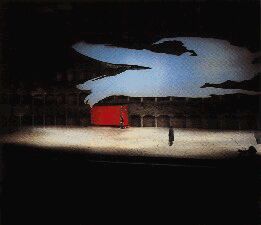 vim wender's WALK ABOUT THE VILLAGES.. mythic enough for you guys???
|
|
B-1] THE TRANSITION NOW I WANT TO SPEND SEVERAL IMPORTANT MOMENTS ON Handke's transitional play THEY ARE DYING OUT, and on THE TRANSITION in general , which occurred, as far as the medically trained part of me is concerned, as much for reasons of health than to make an impact on those who are engaged in discussions about post modernism.
DYING was written no longer written in Berlin, but in Kronberg, outside Frankfurt, where Handke also wrote SORROW BEYOND DREAMS, and I think completed in Paris. That he would not stay long in Berlin became evident to me when I visited him there to discuss the Kaspar translation, in 1969; a prince's loan apartment barren except for stacks of newspapers, he showed off his baby, and in retrospect am I ever glad to express interest in having these fruits of our loins shown to me. A CHILD'S STORY recounts the Berlin and Paris in those days, and to the best of my comparison Handke is as succinct and accurate as need be. Squeezed in between the leftist students on one side who had no time to look at the baby, and the police on the other, who probably would not have either. In Kronberg he was living in what's called a "bungalow" enclave, which is not quite a Los Angeles type bungalow, but dwellings for the well-to-do business folk who commuted to Frankfurt, possibly Handke's first observation post for the mores of the new West German bourgeoisie, fine food for derision in DYING indeed! That Handke, then, withholds showing you something, if he happens to be pissed, goes nearly without saying.
While I was translating the play in 1973/4, Handke wrote and apologized that for a moment he has lost his concentration... Handke went through a personal crisis during which some of the mines that his unresolved childhood trauma had laid for him, blew up. It was not just the suicide of his mother, but his first wife, the actress Libgart leaving him ["the worst thing that ever happened to me"], and for multiple cause, of his emotional unavailability [see THE SHORT LETTER LOG FAREWELL where the author seems to realize he is being pursued by his wife, but her emotional attempt at contact is translated into an actual pursuit], and left with baby Amina to care for. [The language regulation for this event is: Libgart Schwartz has decided to resume her acting career.]
Handke's emotional travails are recounted for all to read in THE WEIGHT OF THE WORLD, A MOMENT OF TRUE FEELING, and NON-SENSE & HAPPINESS, and, as he resumes his extrication process and move away from the metropolitan pressures, in THE LEFT-HANDED WOMAN. The move to the woods outside Paris is prepared around LEFT-HANDED WOMAN time as careful readers of MY YEAR IN THE NO-MAN'S-BAY can deduce.
THE WEIGHT OF THE WORLD mentions that Handke saw a therapist who pointed out his unemotionality to him, something with which Handke agreed, and I think this may be as closely as one can pinpoint the thawing of his derisive self, or that famous moment in MOMENT OF TRUE FEELING, where Keuschnig is overcome with love at the sight of a few sentimental objects & his suicidal impulses & his petulance ceases; at least for then. Moreover, THE WEIGHT OF THE WORLD contains mention of Handke's admission into a hospital for what appears to have been a tachycardia attack, and his subsequent concluding that, after all, things weren't really as worrisome as they had appeared, and it seems that Valium took care of some of the excess anxiety, if not of the narcissistic injury. The language regulation for that event becomes: Handke has one lousy heart valve, which, however, does not seem to have prevented him from having passed his physical for the Austrian Army, the only achievement that Handke's unequivocally hated stepfather ever expressed any pride as we can find out in THE LESSON OF ST. VICTOIRE, which also reveals that, as far as Handke has been able to ascertain, no one in his family suffers from the same kind of bouts of occasional color blindness as he does. At that point, also for reasons of physical and emotional health, Handke becomes one of the great walkers on earth. Quite right: good roads make for bad people.
With THE LEFT-HANDED WOMAN Handke begins to move into Mytho-Poiec openness, which I noticed, and much aware of the critique that this evasion into eternalism was still being subjected to in Post World War II German thinking, found to be worrisome, though I was willing to give Handke, not so much as a person, but because of the extraordinary quality of his work, that extra piece of slack before falling into the usual critical rut. But what I am driving at here, chiefly, is that Handke suddenly started to become emotional, and that the moment he had lost his concentration concerned an emotional moment in DYING which then was changed back into the more customary previous derisive one at that point. What conscientousness on the part of an author towards his translator, too!
B-2] One way of posing the question literarily is something like this: what do I do if I have just written this sequence of modernist plays, starting with A B C D, and taken it all the way to X Y Z, last of all the hugely successful anti-boulevard play LAKE CONSTANCE, but are someone who prides himself on not repeating himself. One answer might have been to become a hugely successful boulevardier, a la Ferenc Molnar, Noel Coward, George S. Kaufman... Oscar Wilde... for R.A.L.C. also happens to be a marvelous inversion of a BOULEVARD play, and you can also have a lot more fun that way, but you are not going to be awarded the Laurel Crown.
And DYING certainly starts out like that - I have pointed to a connection in my discussion already. It is a continuation of VERBAL GAMES but by other, contemporary means , A DIFFERENT KIND OF ARTIFICIAL LANGUAGE, yet very much of that then TIME.
Handke puts the political talk of what was then the young left - but, most improbably - into the mouths a bunch young business folk, who form a cabal, a brotherhood that wants to create a monopoly, restraint of trade, which in fact is how you might think of the historic peace between labor and capital in West Germany at that time, under the aegis of the cold war, no need really for an estrangement effect, since that language is so strange itself in those mouths. For example the Marxist subject of "alienated labor" then reads like this:
VON WULNOW: [an aristocratic super-market chain owner, a very typical route for the ex-German general staff officer type to take] ".....Moreover, in the good old days the workers used to take pride in their products ; when they went for their Sunday walks they proudly pointed out to their children anything in the vicinity made by their own hands. Nowadays, most children haven't the faintest what they parents do at work."
KILB : [the gnat in the navel of the economy] "Why, do you want them to point out the bolt in the car which their father personally screwed in, or the stick of margarine Mother wrapped herself?"
Von Wullnow: I don't have my cane with me. I refuse to touch you with my bare hands.
All of this is very funny in a talking-head sort of way, very much within the Viennese - Nestroy, Raimund, von Horvarth - tradition, and represents a kind of time capsule of leftist blather of the time; and is still a way of being Wittgensteinian, too.
Procedures of this kind replace the verbal games of RIDE but seem to make rather better sense, at least on the surface, seem of greater import, say, than the pin in a dream that's now been found in a haystack, or the drawer is stuck, which the happy crew in RIDE then decides to leave stuck, to mention just two of RIDE's high points, and certainly do not have the same kind of dissociative, dream-state inducting effect, except for stretches perhaps, if the play is done really well.
And because DYING seems to make sense!, I recall Robert Kalfin, who had enjoyed great success with MY FOOT MY TUTOR & SELF ACCUSATION & KASPAR at B.A.M. turning down DYING, but perhaps he had failed to catch RIDE at Lincoln Center, and perhaps he'd never understood what Handke was about to begin with but, like so many other folks, simply did these plays under the banner of their being "avant garde."
So DYING was not premiered for about five years in the U.S. until Lloyd Richards saw its value for the Yale Rep, and it's being a Brechtian Viennese comedy of sorts I put a lot of time in with a famous American lyricist/ composer team whom, unfortunately, except for one new song, their chief being a lazy lout, tried stuffing all kinds of wonderful but not entirely appropriate numbers from an aborted show of theirs into this one. The production had a most wonderful supporting cast of businessmen, including a delightful Kilb, but suffered the lack of an actor, he might have been played by a dictatorial dwarf, whose presence might outdo the cabal; and a dreadfully ordinary Paula Tax. Quitt's mad wife was played to perfection by the director's mad wife!
I presume that the kid from Griffen with the x-ray vision had spent little time with the new German business folk of those days, except in Kronberg, of course they were on TV, you could read about them in the papers, as types they existed in the old plays, and except that the magnate Quitt who takes center stage in DYING could easily have been modeled on Handke's chief publisher, Siegfried Unseld, the head of the Suhrkamp Verlag, who was going around saying that his company was going to be a bellestristik monopoly of ONE! Unseld's big self and Handke's over-weening self both enter into the figure of the upstart Quitt who decides that he will not abide by the monopoly agreement and screw the brother horde. Quitt throws his self into play, he not only has the power of the better and more powerful also deeply irrational arguments but of his presence.
Photo towards the bottom left side of the photo page:
http://handkelectures.freeservers.com/photo.html
Gerard Depardieu with Franz Kilb, the gnat in the navel of the economy who owns a single share of every corporation,and thus has the right to make a nuisance of himself at every stockholder meeting, in a sweat box. In France and Germany and the Spanish-speaking countries Handke is done by the best directors and best actors. In the US this has occurred only twice, RIDE at Lincoln Center, and with Kaspar at B.A.M. I am less well informed on the various British and Australian productions, but know that the ones in London were supposed to have been first rate.
At the end of the play Quitt does what no such magnate has ever done: he commits suicide on a rock full of slithering snakes! Yes, how do you kill off a magnate in a play -- usually they become philanthropists, these upstarts, these once raging bulls, these sons and daughters of milk men, then become involved in style, in styling themselves. Also: a magnate fascinated by poetry, well Siegfried Unseld and Handke formed a team of sorts to enable Handke to become a classic in his own life-time, also because Unseld himself was an upstart who believed in reviving the culture, not that this kept Handke from drawing devastating portraits of Unseld, the publisher, in THE LEFT HANDED WOMAN or in MY YEAR IN NO-MAN'S BAY, of which the subject allegedly was even proud! Alas! What it takes to build a bloody culture! And Handke is fortunately too driven to become entirely involved in style and power, he is truly a great exception in that respect, at least of my acquaintance, well no, there is Philip Roth., who doesn't come across as self-satisfied.
However, DYING - and that is what I am after here - formally entirely lacks the conceptual wholeness, brilliance of the previous or future plays. and so like a mismanaged dream, an unsuccessful compromise, has lots of raw edges showing, but is therefore easier to analyze.
Aside all these business shenanigans, there is a sub-plot that involves an affair that Quitt had with the business woman, Paula Tax, and thus there is a triangle that involves Quitt's mad wife. This is all wonderfully unsentimental & bitter stuff.
Then there is Quitt's relationship with his factotum Hans, which enunciates Handke's persistent theme of top dog underdog, and which is easily reminiscent of the the relationship of Herr Puntilla and his servant Matti, if that is where you need to find your reminiscences, as it certainly one of mine, since that happens to be one of my favorite Brecht plays, if only because I used to drink whiskey at one time.
However, DYING, with it wonderful pitter-patter, and some beautiful long, modulated speeches, one of which - Handke's all purpose salvo - reappears in THE PLAY ABOUT THE FILM ABOUT THE WAR, and I think most interestingly and important, is a piece of deep and various equivocation; and not only in matters of emotion. Considering the socially satirical aspects of the play, Handke might well have taken the turn that, in the German theater, Botho Straus did, and gone on to decimate the always so decimatable nouveau riche. However genius our man may be, as unsociable and easily nauseated a genius he is too, and seems an unlikely, though often tempted, candidate to perform that task. It requires a greater love-hate relationship with that world.
Towards the central part of DYING, Quitt's factotum Hans reads an Adalbert Stifter excerpt to Quitt:
HANS: "....'I shall have to let you go after all,' his uncle said one day at the end of a midday meal, just as a magnificent thunderstorm was breaking, sending the rustling rain like diamonds down into the lake, so that it twitched and seethed and heaved.... The venerable old man happened to be sitting in such a way that the lightning flashed illumined his face, and sometimes, in the dusky room, it seemed as though fire flowed through the man's gray hair and light trickled across his weatherbeaten face."
and Quitt waxes nostalgically about the passage.
Then, at the beginning of Act II, Hans & Quitt discuss a lower-depth type play that they have seen together, my hunch is that Handke was specifically thinking of the early work of Franz Xaver Kroetz;
QUITT: "...You're making fun of my language. I would much prefer to express myself inarticulately like the little people in the play recently, do you remember? Then you would finally pity me. This way I suffer my articulateness as part of my suffering. The only one that you and your kind pity are those who can't speak about their suffering."
HANS: " How do you want to be pitied? Even if you became speechless with suffering your money would speak for you, and the money is a fact and you - you're nothing but a consciousness."
QUITT: " Pity only occurred to me because the characters in the play moved me so - not that they were speechless, but that despite their seemingly dehumanized demeanor they really wanted to be as kind to each other as we spectators who all live in more human surroundings are already with each other....."
Between the polarities of the Stifter quote on the one hand, and the discussion about feelings of the "simple" people on the other, Handke would find his opening to the mytho-poiec, and what an exorbitant solution it would be once he arrived at it about seven years later.
|
|
|
THE MYTHO-POEIC
WALK ABOUT THE VILLAGES
C-1] W.AT.V.
The solution that Handke found to the problematic sketched out at the end of the previous section is so exorbitant that I am astounded even now. And because the change is so momentous I will spend the requisite analysis on it.
For those of you who read German and the Romance languages you might want to take a look at DIE GESCHICHTE DES BLEISTIFTS [History of the Pencil, l'histoire de crayon]. [X] the successor volume to Handke's "naked ego exhibition" WEIGHT OF THE WORLD, which I have already mentioned in a different context. BLEISTIFT begins by continuing nakedly for a time before, now selectively edited, BEFORE it turns into one of the great work books, on the order of Klee's or Beckmann's, where you see Handke's note to himself how he will proceed:
QUOTE [s]
He will not take the Kroetz route and show the lower class in all their misery; moreover Handke, at least not until the recent SUBDAY BLUES - I hate to have to say it - was never any kind of naturalist, although the highly knowledgeable and sensitive interlocutor, Herbert Gamper [X], who conducted the three day interview ABER ICH LEBE NUR VON DEN ZWISCHEN RAEUMEN ["But I Only Exist on the Thresholds] with Handke in the 80s, which is counted among Handke's own works, pointed out a certain linguistic naturalism that was bound to mark the instrumentalist manner in which Handke used words, say, for dissociative and other purposes that I have tried to describe. And since Handke has no great liking for the upper classes...
"Behold our gentleman, the architect, just now ascending from the cellar, cradling the bottle in his arms, and show the visiting gentleman, his counsel, the vintage label, while Mistress Architect in the next room puts it to Mistress Counsel how she has flushed out a new butcher or a new baker, of whom the form lards venison ready-to-roast and the latter's' beribboned tarts unfatten the fattest fatbag...."
he will transfigure the lower classes:
"The land, too, was only made arable with the labor of their hands: they seized a spring in a rock and laid pipes yards underground - do you know what that means? - leading the water to the garden and to the house. The boulders were stacked into terraced walls....'
" I am a worker. I was, I can say, born as a worker. I don't want to be like him. I am not keen to eat what he eats, to drink what he drinks..."
"Perhaps we are the exploited , the downtrodden and insulted, the salt of the earth. But we, too, often get up at night. We like to piss into the soft cement. Every so often we see the stars circling in the corners of our eyes ... We are the figures walking in the distance through the field, the silhouettes in the cross country bus which drives through the snow-plain. Our shadowy faces fill the first to the last subway car and only in the curves do our eyes briefly lose touch...."
However, these are really not the same lower classes that Kroetz [X], Gorky and no end of exploiters of the abysm or of broken language of the prole have in mind, and which none of those there so portrayed ever come to see, if only because their funds are devoted to other matters. Moreover, as compared to his own stepfather and mother's relationship, which in fact more closely resembled a Kroetzisch kind of misery, Handke, quite knowingly, turned these people into what might be called "the better working class", self-made as it were, little Quitts if you like, and the initial Credence Clearwater Revival quote: "rollling on the river" - from PROUD MARY- I think indicates that Handke is more interested in Neill Young, Otis Redding working class populism than in the abysm that Kroetz explored for his purposes, where no nobility and articulateness can be found, but a lot of emoting, or not even that.
With the exception that our friend, the paranoid/schizophrenic inducing construction worker and ex-goal keeper Josef Block reappears as Albin, one of the three worker/clowns: " Otherwise, you know Albin as the fellow who bellows in the empty train stations at night. He's the guy with the switchblade, the smart -ass with the klaxon by the bar who hurls his mug against the mirror, then plunges headfirst into the next beer belly. Hes the grinning killer with the badge of skull and bones. At public demonstrations he's the uniformed officer who wishes every civilian for an enemy. In the midst of peace he lets peanut shells crackle as though he volunteered for the firing squad. Albin has served time. He knows the emergency exit in each room. He sits in the porno houses and stinks. He plants himself right next to you in the otherwise empty bus and whistles through his stump teeth the entire trip. At night he mucks around the swamp and emits death yells. He takes a cart shopping for his crippled mother. His gravestone says: "Vamos." He is also a woman: you touch him and he yells: "No tickling." At soccer games he stands in the goal as the specialist for high shots but misses everything that comes in low. At wakes he is the only one who stays with the mourners all night long. In forests he steps out of the crack in the hollow tree trunk. He stands in the old wagon trail tracks with his divining rod while his dog slobbers stickily all over your Sunday best. He is the one who crawls out into the underbrush a dynamite stick between is teeth. He is black and blue. The sacred bull sits on his tongue and makes him speechless. He lay with you under one heart and appears to you as a face in the clouds. His last photo is black and white and oval, and his mangled bicycle lies by the mile stone in the grass. His sign is the atrophied thigh muscle from lying in hospitals too long...Who is he? He is a riddle. And woe to you who dare decide who we are!..." Mr. Handke's dumbstruck autistic twin, as it were, had Handke not had the good fortune to be picked by a priest to attend seminary; poor Bloch, some may recall, subsequent to misinterpeting that he had been fired, throttled a woman he picked up when he saw some water bubbles on a hot plate scurrying about like enraged ants, found his way back to his home village at a border region, and it seemed that his arrest was momentarily expressed by his catching the penalty kick, to all our immense surprise, in his midsection, as I imagine a policeman putting his hand on his shoulder and saying: "You are under arrest." Thus the time spent in various institutions..... What was left to the imagination of those who can be affected by the kind of metaphoric and self-state, paranoid/schizophrenic inducing writing that is GOALIE is now articulated in a different narrative fashion, leaving a lot to the imagination, too, of course, but differently so in a different medium.
VILLAGES has a bit of a story line, an occasion, a premise: the prodigal son Gregor returns, stage manager Nova intones the opening poem: "Man from overseas, spectator mask over our cheeks. You had no ear for the surge of the subterranean homesickness dirge. Blind to the drops of blood in the snow, wanderer without shadow. Hand among hands on bus straps you stand. Northhsoutheastwest sire, but now I'm mired."..to settle a dispute over the land that their parents left him and his sister and brother: "My brother wrote me a letter. Is is about money, about more than money: it is about the house of our dead parents and about the piece of land on which it stands. I, the oldest, inherited both...The relatives became like muffled voices in the snow. Just once did one of them suddenly come close again. One evening I watched on television the story of a teenage girl who was shunned by the entire village as a rape victim and who finally killed herself. She wrapped herself up in a shawl or in a cape and rolled down a river embankment in it. She kept getting tangled of course, in the bushes or in the tall grass, or because the slope was too flat and her momentum still too faint. Finally, though she succeeded, she plopped into the water and went down at once, and with the organ music which set in then I was seized by a crying fit. It was actually not a fit, but a kind or release or liberation. The room that night that time is a very clear and wide space.... " which quote from Gregor's opening speech integrates , seamlessly, a momentous scene from a Bresson film, as Handke integrates the classics as though they lived today [the sort of thing that might give a new task to all those poor grad students still slaving over Benjamin's Arcade Project.] Handke may be one of the best read writers in any language, and his lack of literary in-ness is a delight, especially by so many comparisons; and Handke writes as little for graduate students and professors as people dream for their analyst, unless they are in analysis!{X}] and the village re-arises in all its misery and glory, and scarcely idealized as no end of programmed German and Austrian non-readers seem to write, but variously represented.
THE OLD WOMAN: I would like to damn this village and its inhabitants who only listen to the ringing of the electric bowling alley. I want to damn their mouths which are like piggy-bank slits into which you put something but nothing comes back out. I want to damn their fake native garb, with the gypsum white stockings, the leather storm trooper straps across the chest and the stag horn buttons, big and worm-eaten like death heads. [A very Austrian/German/Swiss contemporary village in other words. The U.S.A. has no villages left, merely places called villages. And a shoddy ideology of the rural life, what I want is some sentimentality about Agri-biz!].
GREGOR: I have a liking for this spot, which is not the village as for no other place no matter how alluringly afar. I am literally proud to have been born in these parts and it means something to me to be in the register here. Earlier, as soon as I saw the wall and tree tops from the distance I wanted to be already here. I flew. everything flew...
The classics having become, as Handke says, his salvation, and so here is an instance of the Stifter revision - you recall the whiff of a quote from DYING OUT - - as it appears in Villages "The way here was very long. Even at the entrance to the valley dust clouds from the various construction sites were blowing about. The water in the river was muddy from them.... But then I took the high road between the orchards. The dust clouds were drifting along the opposite slope; in addition, truck convoys whirled up sand, the light occasionally turned sulfur yellow; all this achieved a certain rightness with time, it reached over from afar as a kind of beauty. A single person came towards me, dressed in black, he was walking home from a funeral, and down in the valley I then saw the grave diggers in colorful vests with silver buttons...
Follow the gaze of your cat, when it peers past the cement edges into the emptiness. There the water quivers in a bowl of trees and rebounds as a larger heartbeat. So that you finally raise your arms. you valley will perhaps be old again at the flick of a wrist, and the cement arches will be formal links to the most ancient antiquity."
He will go back to Euripides and Goethe and avail himself of what is called "alternating discourse," long declamatory dramatic speeches, that recast ordinary speech in a somewhat transfigured, if that is what you want to call the above quotes, manner. Alternating discourse is not dialog by another name, but you might say: statements, assertions of self [selves], arguments within a larger dialog, and they can run to five thousand words, are carefully and powerfully composed as the above quotes show, and as I already mentioned, each of the characters' speeches is marked by a syntactical mode of their own, as these statements were in the ancient and classic dramas: Instead of naturalistic speech mannerism, a manner of speaking, a deeper beat. As in Greek drama, horrendous events take place "off stage", this is a play that is for those whose curiosity for the horrendous is sated; it's music arises out of a sense of tragedy, melancholy and pathos. As I keep saying, the only region in the U.S.A. where some sense of tragedy prevails is the American South, as deficient and skewed as it may be there, too. The remainder of the 50 federated states has a new set of virgins born every generation, who keep going: "Duh."
With Gregor's opening speech above, compare that of the SITE MOTHER: "You are lucky. It is a good day. The work here is slowly coming to a close. Next week the crew goes to another project, into the other valley. Most have already been resettled. Your brother and a few stragglers are seeing to the finishing touches..." the sort of thing that teaches you all manner of other things beside underlying speech rhythms, about approaches, etc.; or that of SOPHY whose inflections, throughout, have a querying upward beat at the end of most sentences: "Did you know that I used to be in love with you? I didn't just like you as my brother -- when you appeared I became exited: as though you were The One. You were the person I longed for: whom I could believe...
==================================================
However, first things, well not quite first:
W.A.T.V. is prefaced by several quotes, aside the one from PROUD MARY, and each of them is to be taken seriously, even if humorous and a touch misleading as all that Dordonna Oracle business at the beginning of HOUR, as are all the other little pointers that Handke sets up at the beginning of his works:
1] "Here I stand" i.e. I am having my say, and I say it simply, but I know how to articulate my position, my complete say, or at any event, the most articulate say I am capable of. This also indicates that the play is entirely STATIC; it is calm, restful, undistracting; it allows the listener to reach with his ear into the language, if there are any such listeners still about, though one might think so considering that Shakespeare still draws, but perhaps only as a cultural duty? "I saw this spot as the color and form which had been cleansed of everything secretive, everything parochial, everything atmospheric, everything typical, everything manic."
2] "Everyone is in the right" ... something that I think ought not to require comment, yet a moment of reflection about its implication in a series of dramatic speeches whose positions, interests, opinions are not in agreement with each other would not be out of order; yet which do not cancel each other out, nor resolve into some kind of bloody Hegelian higher order.
3] "Play on after the last words" ... the author at his most hopeful!
4] "Heartfelt Irony" ... to which I commented at the lecture as I gave it in Seattle, whether maybe irony, if heartfelt, might it be understood by the phlegmatic dunces here in Seattle "Who even on baby legs stand there like butchers, bug-eyed like the slaughtered....."; but indicates Handke's, then, kindly attempt to rein in his older more customary derision, which is not to be confused with such lying slogans from on high as "A kinder gentler nation", or "compassionate conservatism" no matter that the nation's soul invariably responds with the wrong little leap of hope when such slogans are introduced into the sponge-noggins, and its paid speechefiers, headline-mongers perpetuate the distracting lie. There are also passages of immense affection, devoid of ironic acid of any kind.
5] Nietzsche's "Tender and slow is the pace of these speeches," from the otherwise ressentiment-ridden Ecce Homo, which points towards a way of speaking as it is exemplified most tenderly in the play's Slovenian quotes:
THE OLD WOMAN: "Do you believe in miracles?......"Do I have to tickle the story out of you as one tickles the egg out of a chicken? Like the egg out of a chicken's behind, out of its ass-hole? [She demonstrates and laughs. THE CHILD laughs too, demonstrates and rattles... THE OLD WOMAN: continues to remember and finds her father's original sentence: ""Bom scegetal zgodbo iz tebe kot ajace iz kokosi."
===================================================
The play has three sets: One is simply in front of the curtain; the other two are [Act I] a construction site and Act II in front of a cemetery wall, with a tree in back;
The characters are: Gregor, the prodigal son; his brother Hans, a no-good modeled on Handke's petty criminal half-brother, a construction worker; his sister Sophy; the Construction Site Mother; and it is a good thing for a translator, so I tell myself, to have worked "among the people" and so to learn the vernacular; The Old Woman; and the three clowns as construction workers...Albin, Ignatius, and Anton; and Nova, commentator, Chorus from on High all rolled into one all around girl, and stage manager as Handke introduces into all these Mytho-Poeic plays, from VILLAGES to ART OF ASKING... PREPARATIONS FOR IMMORTALITY to THE PLAY ABOUT THE FILM ABOUT THE WAR... which cast affords Handke ample room to express a veritable refracted rainbow of takes on the issues at stake; and THE CHILD, who rattles and pounds a stick at significant moments but provides the central vantage point. - A CHILD'S STORY, the second part of the A SLOW HOME-COMING CYCLE [of which the narrative by the same name is the first, THE LESSON OF ST. VICTOIRE the second, and W.A.T.V. the last] is also the inception of Handke's realization that children have a point of view! With touching belatedness one might say considering he had been father/mother to a daughter for about ten years by then!
An indication of what I am not the only one to have called Handke's "mediavalism" is the recourse to it and a new yet ancient but for Handke unfamiliar rhetoric for what for a better term can still be called "estrangement", historicizing purposes, and this medievalism is a true stroke of genius, whereas the "child's perspective" is a bit questionable in Handke the didactitician's hand, to make us keep taking a fresh look at the world over and over again. The "medievalism" in one fell stroke combines estrangement & a sense of the epic in one, something for Brecht scholars to chew on if no one else.
"You're in a country that is as small as it is mean; that is full of prisoners who've been forgotten in their cells, and even fuller of forgetful jail keeps who are fatter in their offices after every infamy, with voices that sound as if death-rattle amplifiers had been built into their throats, with the arm and leg movements of poisoned grappling hooks, with eyes where killer wasps slip out with every glance. even their snow tracks are like the imprint of torture tested steam irons...
"Years ago they would have been enveloped in a clouds of dust and horses' hooves would shake the ground, white foam have flecked the field, the horses' snorting amplified by a curved iron mounted before their nostrils, and their war song have meant: finally it's getting serious - finally these hills , these gulches are the terrain for war."
"Yes, their hands are ready for any defenestration. they have masks not faces, their eyes are nothing but darkened pupils, impenetrable and distended by sadness as once upon the eyes of kings as they broke camp for realm of death and your brother, walking in front, waves the black flag.".... we are approaching the highest order of dramatic rhetoric here. I have already introduced some quotes from VILLAGES, for contrasting purposes, about "endings" in Section A, which are mediavalistic in nature, as well as resonate with at least the disappearing tail of catholicism.
============================================
When Handke sent me the play in 1081, the galleys were accompanied by a note saying "Nothing for business, solely for slow and careful reading," indicating his awareness of my constant financial anxieties, which concerned the firm of which I was co-publisher, and that he was sufficiently realistic to know that VILLAGES would be far more frequently read than performed, an assessment that unfortunately has remained the case. Suffering from the one and only instance of anemia in my life, and so being even more than usually feeble-minded, I responded to what I felt was VILLAGES' suffusion with rural Catholicism of the best kind, mingled with paganism too of course, [to which this born, and again pagan and now somewhat acid-splashed pantheistic animist responds as a matter of unmentioned course] of the best kind, too, as may of course be evident from the quotes above:
NOVA: "Although there is no one inside, the quadrangle stands there as for an event; as though something should happen there, soon, even today, this very hour. The holes in the wall are ready as firing slots were centuries ago, and the gilded script on the war memorial smoulders, the dank inside the boxwood hedges is aflutter with moths and other nightlife. Empty beer bottles lie in the octagonal bone yard. Clear plastic has been spread over the stitched altar cloth, with a dying hornet grappling on it. Many gravestones have inscriptions in a foreign tongue. Yet nothing is ominous... The sky above the quadrangle is like a vaulted ceiling in a spacious room. As I walked on the diagonal below an airplane flew along the diagonal above. The bell swayed gently in the tower and looked like a man on a swing. Through the gate in back you can walk on into an orchard. It seems to me as though this is not just a place but a show place, and as if the darkness on the walls were not just the soot of ages past but of the color of what is to come, of a thunderstorm, of a swarm of arrows that will darken the sun. It is the emptiness before the feast."
The last dramas are those of "places", and as I indicated in section A, what Handke creates, chiefly here, is a sacred play space, this is a different way of 'vacuuming' the stage clean, from RIDE'S, different but not just of another kind, since the process of cleansing is performed on a historically and psychologically more formidable level
Moreover, Handke's recourse to the serial method, whose construction from the simplest of means I tried to show in Part A, that too has undergone a change, and will remain recourse to this day:
"Oh summer and winter, parks and plazas, rows and roofs and wooden benches, arbor walks and train stations, fiery smoke and planes at night, stillness and roaring -- river whose answer I became time and again, river whose gleaming and rustling time and time again came the answer "I" -- ah wide world! - and everywhere in between the clattering, the battering, the snickering, the muttering, the dickering, the sputtering, the cackling, the heckling, the simpering, the scribbling, the groveling, the shystering, the badgering of business; the mal-odor of business, the malfeasance of business, the malevolence of business, the base hypocrisy of business, the eternal scandal of business; the damnedness of business...I want to go to justice..."
====================================================
C-2] W.AT.V.
To my noting the work's suffusion with a rural catholic ethos Handke objected, not just once, but several years later a second time. "That is not right." Meanwhile Handke appears to attend a small Russian Orthodox Chapel in his region outside Paris & in the second of his Serbian travel books confessed to believing in the Trinity, though in his case I think it is the grandfather, his uncle, and with himself as the holy ghost! Moreover, the only real friend of Handke's that his alter ego Keuschnig visits in NO MANS BAY, who is not merely a well-developed side or split off part of its author, is an Austrian country priest, whom I just as soon not boil down to a type, though I think Catholic country priests whether they work in Ireland, Mexico or Austria face some of the same problems with the refractory dunces with whom they are entrusted.... that make them occasionally into not just listeners but stern taskmasters if need be in herding their brood.
"....a moment ago still your pointman's hand during our first Holy Communion procession - a moment ago still too pudgy fingered for the fat votive candle, a moment ago still drip-wet with holy water!...." and there are some earlier medievalist quotes, as well as the second scene in front of the cemetery wallHANS: [turning to the Old Woman]: "There is no consolation."
THE OLD WOMAN : "There is no consolation."
HANS : There is neither knowledge nor certainty, there is nothing whole, and what I think I think alone, and what occurs to me alone is not the truth but an opinion, and there is no such rule as universal reason, and collective human destiny walks about more than ever as a ghost.
THE OLD WOMAN : The vinegar sponge doesn't even have vinegar an more.
HANS: The man with the redeeming glance is rattling full of millstones.
HANS : Church spires jut like spears in enemy country.
THE OLD WOMAN: The side-wound has a stench, and the ruby-red gleaming stars are the killer bear's.
However, the two objections to my response indicates, I think, that Handke hoped to salvage the same kind of sacredness without recourse to any kind of official church sanction... and was/ is perhaps unaware of how deeply rooted our ex-seminarian is in the better part of catholicism, as it also pertains to the sacredness of the logos.
"...for sacred scripture has been written and sacred pictures painted..." I think at least hints at Handke's ambition, then in the early 80s, to at least make a small addition.
The play stood me in good stead while I worked on it, which took altogether six months. Once I was done, Handke was so happy that he seemed to think I had written it myself. This baffled me to no end, until I understood the degree to which he absorbs the works that he translates himself. He also found my work "cutting, and in the good sense." I certainly was in a cutting mood as I shouted the work out over and over sentence by sentence in my then empty loft, and it turned into a piece very much "for voice", and thus not with as much heartfelt irony as the author might have wished for. Yet the work became my "heart test", to see whether the heart part of heartfelt irony actually manage to penetrate some of the the ice floes in the overall frozen sea, and I am afraid to have to report that though the climate may be heating up and the permafrost thawing and the trees in Alaska no longer standing upright, human hearts have not melted or respond well to a literary heart tests, no matter the endless hypocritical platitudes that pervade contemporary culture - a Mexican village, not too close to a major route, is another matter.One mutual acquaintance was much taken by the line about the "hefty taxes."
With VILLAGES Handke evidently had created a new way of writing theater ... the alternating discourse method becomes Handke's new formalism, and he resorts to it, or used to [SUBDAY BLUES throw a lot of matters into question] and returns to the gold ground of this play whenever he is at a loss, or does not seem to know how to go on, even in THROUGH THE SIERRA DEL GREDOS, and as as a matter of fact, so do I since each sentence became enriched by nodules of associations.
"Land, lower your flag and coat of arms. Valleys all, strike your hymns, forget your names. Ways here, shelter yourself in namelessness... Construction site, here, you too, as in the old saying, animate yourself in nameless simplicity."
"At dusk it is quiet and empty there, the mounds are enshrouded , the glaciers have melted just now, it is ten thousand years before out time, and it is our time...." ,
"A few centuries ago it was the practice in this valley to make so-so-called leaf-mask. Between woodcut leaves a a mouth opened and out looked human eyes. Once I saw us - not just us three - thus together in the foliage. I walked late in fall...
However, in certain instances, such as some long passages in PREPARATIONS FOR IMMORTALITY the demands of balance that the laws of formalism exert run rather thin, just a thin buzzing of the violins, though nothing as obnoxious as the crazy pseudo baroque of, say, Phillip Glass, but is a play that I will not discuss in detail, if only because it is not in English, though of course it exists and had been performed by important French and Spanish speaking troupes, for those of you who have those tongues, a fabulous strong, typically Handkean strong opening, but for reasons I have not taken a close enough look at, quickly gets into trouble. And I don't think it's because of the laws of formalism, but because Handke's concepts in some instances, subsequent to ART OF ASKING & HOUR, are perhaps greater than his ability to execute them to their fullest.
I now come to section "D", and THE ART OF ASKING, where on the now re-sanctified "play space" a set of pilgrims begins to move, ever so incrementally.
==================================================
|
==================================================
|
|
|
D- ART OF ASKING
The stasis, the utter calm of "the clean place" of W.A.T.V. ... starts to move, but ever so incrementally: even in instance of the manner in which the scenes are numbered: 3.1., 3.2 etc - once the site [the stage, of course] and the tasks [the trip & its game of learning how to ask questions] - have been established. The perspectives, the vantage lines from the end W.A.T.V. shine into the ART OF ASKING [A.A. from now on].
W.A.T.V. made several invocations to the imagination:
QUOTES
and it is in the artificial space, the stage of A.A. that the imagination can take flight more than in any other Handke's play.... because time is slowed down to a walking pace... while the variety of techniques that Handke uses and that I have previously enumerated are used more discreetly, with greater refinement, sovereignty; chiefly, of course, the oozing of time which made its first appearance in his work in MY FOOT MY TUTOR [MFMT].
A.A not only uses the alternation discourse of the long speeches of W.A.T.V., but many of the compositional and dissociative techniques dating back to MY FOOT MY TUTOR & THE RIDE ACROSS LAKE CONSTANCE, the latter Wittgensteinianism quite discretely. And it does so for a truly extraordinary purpose.
QUOTE
Whereas RIDE dissociates the audience with a veritable basketful of dissociative verbal techniques, non sequitors, and comedy routines of all kinds, A.A gradually puts the audience - hypothetically at least! - into a state of profound puzzlement.... of a kind, speaking for myself, that I had found myself in after about a year and a half of psychoanalysis. Here the same effect is accomplished within about four hours; what is created is only a general state of puzzlement that then permits detailed, focused puzzlement. As compared to the kind of utter lightening, lifting of the "weight of the world" that transpires in RIDE or the wordless HOUR [the subsequent play which might induce puzzlement too, with its archetypal and fairy tale elements, and its making the audience see and hear so much more clearly] puzzlement is a precondition of enlightenment, be it of the light or dark kind: matters have become more serious for Handke, who as a playwright has worked actively within the tradition of Lessing since the very beginning,
What I find most extraordinary in A.A is the gracefulness with which so much of what Handke's tries to do is accomplished, the anmutige:
EXAMPLE
the lightness of his touch. Not that some of the long speeches, especially the first one --
QUOTES
since they, perforce, have not the weight and density of those of W.A.T.V. -- might not be a tad shorter: as a matter of fact, about midway through this speech, I felt like shouting: why not condense some of this into verse!
QUOTES
Just as I had felt about certain long speeches in DYING that they could be turned into song.
Any form of naturalistic theater kills the imagination, prevents it from flourishing, not that naturalism, as practiced in the English speaking theater, has not other uses. But making thoughtfulness is rarely one of them. The problem of naturalism has haunted, preoccupied, of course not only Handke, since his first novel, much of which, so generously, was written in the as if mode, the subjunctive, whereas the ordinary reader, the ordinary audience wants to be hit over the head, and eventually Handke would find a way of doing that too. But the "as if mode", the subjunctive is the sine qua non of philosophical art, no matter that at its origin lies an emotionally determined defensive mechanism; but psychologically, as Helene Deutsch was the first to elaborate Freud's observation [XX] and as, say, it is elaborated philosophically by the neo-Kantian Karl Vaihinger's PHILOSOPHY OF THE AS IF. But the point is: once you put the "as if" on stage, the as if, becomes concrete and concretely useful.
I continue to be baffled and amazed that A.A. has not been performed in English, especially so considering the success of HOUR. It cannot only be the truly miserable translation that Gitta Honegger produced, a nice woman, who came too late to the United States, an academic who never lived or worked or walked among "the people" to get a feel for spoken American and what you can do with it. A variety of directors, unaware that W.A.T.V. was meant to be my swan song or be it croak to translating, have berated me, as though it were my fault that the stage directions of HOUR read as miserably as they do.
===================================
A.A., has three acts: [1] the Establishment of the mis en scene: a stage with a plateau, and an imaginary escapement, across which the LOOKOUT in particular does a lot of long-distance peering: he has the epic view, and is far kindlier than his antagonist, SPOILSPORT, whose actions frequently resemble those of the comma pushing prompters of KASPAR, the gloomy grammarians of the here and now, as it were. However, as opposite as these two polarities are, Handke here handles, chiffriert them with considerable subtlety, as compared to the stark, dramatic, unequivocal and more effective way in which he establishes the opposition of the two Juans in the 1994 play PREPARATIONS FOR IMMORTALITY, and its great opening , a real Handkean gangbusters Fifth Symphony type opening it is too, perhaps arrived at from the melancholy conclusion that the comparative subtlety of the polarities in A.A. is effective only with comparatively careful and subtle readers who don't need to be hit over the head.
What starts to move, once the reason for the trip has been established
QUOTES
, are the "ordinary" wanderers of the film-novel ABSENCE - a dentist or a mailman it might be - who have appeared to also wander/wonder on to a stage, but who are now called "Pilgrims"... and there is the requisite Dante quote "The pilgrims looked very puzzled as they were walking....The pilgrims seemed to have come from a long way off...." However, ever faithful, then, to his distinction that actors can only be actors, the stage is very much a conscious stage, as conscious as that of RIDE or W.A.T.V., and the actors are representers, some of them representing actors... acknowledged fictions on a real stage, who play... if you recall my comments about RIDE & HOUR.
This grouping - here in the form of LOOK-OUT, SPOILSPORT, THE YOUNG ACTOR, THE YOUNG ACTRESS, THE OLD COUPLE, PARSIFAL-represents the quintessential, allegorical, freely interchangeable Handke troupe, which can expand or contract depending on demand. In HOUR the troupe, actors of course, expands to a dozen or so. Here this so variable troupe consists of THE LOOK=OUT [who...], and KILLJOY [who....] and A YOUNG ACTOR and a YOUNG ACTRESS who behave in very actorly i.e actressy fashion, and AN OLD COUPLE, the long-married couple has been a Handke find since A SLOW HOMECOMING, a wonderfully decimated skinhead PARSIFAL [who is the, then, latest incarnation of Handke's angry idiot Kaspar, this only to indicate that Handke's dramatis personae , like those in his narrative fiction, have a history of multiple uses, and function as revealing freeze-frame masks, too] and a NATIVE, who appears in the necessary various guises
===================================
A.A., has three acts: [1] the establishement of the mis en scence: a stage with a plateau, and an imaginary escarpement, across which the LOOKOUT in particular does a lot of long-distance peering: he has the epic view, and is far kindlirt than his antagonist, SPOILSPORT, whose actions frequently resemble those of the comma pushing prompters of KASPAR, the gloomy grammarians of the here and now, as it were. However, as opposite as these two polarities are, Handke here handles, chiffriert them with considerable subtlety, as compared to the stark, dramatic, unequivocal and more effective way in which he establishes the opposition of the two Juans in the 1994 play PREPARATIONS FOR IMMORTALITY, and its great opening , a real Handkean gangbusters Fifth Symphony type opening it is too, perhaps arrived at from the melancholy conclusion that the comparative subtletly of the polarities in A.A. is effective only with comparatively careful and suble readers who don't need to be hit over the head.
What starts to move, once the reason for the trip has been established,are the "ordinary" wanderers of the film-novel ABSENCE - a dentist it might be - who have appeared to also wander/wonder on to a stage. but who are now actually called "Pilgrims"... and there is the requisite Dante quote ""The pilgrims looked very puzzled as they were walking....The pilgrims seemed to have come from a long way off." However, ever faithful, then, to his distinction that actors can only be actors, the stage is very much a conscious stage, as conscious as that of W.A.T.V. and the actors are representers, some of them representing actors... acknowledged fictions on a real stage, who play.....if you recall my comments about RIDE & HOUR. And, as a matter of fact, some Wittgensteinian word games reappear, in yet a different form:
quote
This grouping - here in the form of LOOK-OUT, SPOILSPORT, THE YOUNG ACTOR, THE YOUNG ACTRESS, THE OLD COUPLE, PARCIFAL/KASPAR -
represents the quintessential allegorical freely interechangeable Handke troupe, which can expand or contract depending on demand. In HOURS the troupe, actors of course, expands to a dozen or so. Here this so variable troupe consists of THE LOOK=OUT [who...], and KILLJOY [who....] and A YOUNG ACTOR and a YOUNG ACTRESS who behave in very actorly i.e actressy fashion, and AN OLD COUPLE, the long married couple has been a Handke find since A SLOW HOMECOMING, a wonderfully decimated skinhead PARCIVAL,[ who is the then latest incarnation of Handke's angry idiot Kaspar, this only to indicate that Handke's dramatis personae , like those in his narrative fiction, have a history of multiple uses, and function as revealing freeze frame masks, too] and a NATIVE, who appears in the necessary various guises. |
|
|
|
http://www.handkedrama2.scriptmania.com |
|
|
|
==================================================
http://www.handkedrama2.scriptmania.com
|
|
